

Resistance to National Socialism: Pastor Eitel-Friedrich von Rabenau - english
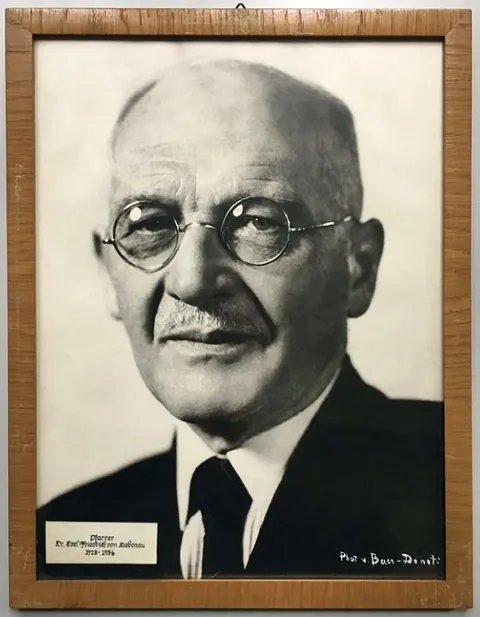
Pastor Eitel-Friedrich von Rabenau (1884 - 1959) shaped the history of the Apostel-Paulus parish in the 20th century through his courage, his sustained and uncompromising resistance against the National Socialist “German Protestants” (‘Deutschen Christen’, DC), and his assistance to the persecuted.
The son of a lawyer, he was theologically pietistic and politically national-conservative in orientation. He rejected Republicanism just as he rejected, for example, the pastoral office for women. After completing his studies, he worked in hospital chaplaincy and in support services for alcoholics. In 1912, he went as a pastor to the German congregation in Jaffa/Palestine. After returning in 1920, he was active for decades in the Jerusalem Association, which to this day maintains Christian charitable institutions and schools in the land of the Bible.
Appointed to our parish in May 1923, he held the parish office here until his retirement in 1954. He succeeded in winning large parts of the congregation for the ‘Confessing Church’ (‘Bekennende Kirche’ BK) and thus also for the internal church opposition against the dominance of the National Socialists within the Protestant Church.
A Founding Father of the Confessing Church
Von Rabenau opposed the German Protestants (DC) from the time of their founding in 1932. After the transfer of power to the National Socialists, the DC gained majorities within a few months in most Protestant church bodies and forced through a radical restructuring toward a system of church governance oriented to the “Führer principle.” They distorted Christian doctrine with elements of National Socialist ideology and established the “Aryan Paragraph” to dismiss all church employees with Jewish relatives.
The church opposition formed in response, within which von Rabenau was well connected. In 1933, he belonged to the founding circle of the Pastors’ Emergency League (Pfarrernotbund), which supported pastors who had been forcibly dismissed. In May 1934, he was among the co-founders of the Confessing Church (BK) and, as a member of several councils of brethren, was one of its leading representatives. As early as 1933, SA men appeared at von Rabenau’s church services and threatened him. Church and state authorities pursued him with multiple suspensions and salary stoppages, as well as with two arrests by the Secret State Police.
Church Struggle within the Parish
In the parish council of Apostel Paulus, the German Christians (DC) gained the majority in the church elections of 1933 organised by the National Socialists. Bitter conflicts followed between the Confessing congregation around Pastor von Rabenau and the DC group led by Pastor Gerhard Peters. DC supporters repeatedly denounced von Rabenau to the church authorities, yet this did not diminish his influence: the initially “neutral” third pastor, Heinrich Roterberg, soon aligned himself with the Confessing Church (BK). Over time, more than 900 members of the congregation joined it.
On the first Sunday of Advent in 1934, the deep divisions within the congregation became widely visible. Despite an official church suspension, von Rabenau was to preach, since Pastor Roterberg and assistant preacher Kube, both close to the BK, regarded his enforced leave as unlawful. However, Pastor Peters forestalled him and occupied the chancel with the smaller DC group. For a long time, von Rabenau from the pulpit—supported by the brass ensemble—and Peters, accompanied at the organ, struggled over the conduct of the well-attended service. Rabenau ultimately brought it to an end with the withdrawal of the BK group.
The conflicts continued for years. At times, the BK group was barred from the church premises. The disputes ended only in 1943 with Pastor Peters’ transfer due to the war.
Open and Secret Assistance for the Persecuted
Pastor von Rabenau neither closed his eyes to the persecution of his Jewish neighbors in Berlin-Schöneberg nor to the distress of congregation members of Jewish descent. The Apostel-Paulus Church stood unreservedly open to them. He sought to give the outcasts “fellowship within the Church of Jesus Christ.” Such an attitude was by no means self-evident in the Protestant Church at the time. Von Rabenau was denounced in an anonymous letter as a “servant of the Jews.”
He continued to baptize Jews who wished to convert, yet he expected that faith — and not merely formal considerations — should guide them. However, baptismal certificates could not protect them. When deportations were imminent, von Rabenau provided pastoral care and enabled some of the persecuted to offer spiritual support to fellow prisoners.
When it became clear that the persecuted faced death, he, his wife Elisabeth, and several co-workers resolved to undertake the risky support of those fleeing deportation. They offered assistance in the parsonage, sought secret accommodations with like-minded pastoral families throughout Germany, and provided material support to the persecuted.
“In this situation we had to endure, proclaim God’s word truthfully and pray rightly; we were not permitted to numb our conscience or allow our thoughts to become confused.”
From: E.-F. von Rabenau, Gemeinde im Werden. Geschichte der Apostel Paulus-Gemeinde von 1923 bis 1948, Berlin n.d. (1954), p. 66.
Photo captions, left to right
- One of the letters from members of the congregation to the Consistorial President of the Church Province of Mark Brandenburg from 1939. They sided with von Rabenau when he was suspended for his longest period, from September 1938 to May 1940.
Evangelical Regional Church Archive in Berlin, ELAB 14/4412.
- Renate Wolf (l., later Rahel R. Mann, 1937–2022) at her confirmation by Pastor von Rabenau (r.) on 29 March 1953. Her mother was a baptized Jew; she never met her Jewish father. Pastor von Rabenau baptized her during the war. The girl survived the persecution in several hiding places, receiving assistance also from the von Rabenau couple.
Source: Private collection / German Resistance Memorial Center.
- The Jewish couple Ines (1894–1972) and Max (1888–1965) Krakauer in June 1945. In Berlin in January 1943 they fled to escape deportation and asked Pastor von Rabenau for help. He gave them money for their escape, during which they found refuge in more than 40 parsonages until liberation.
Source: Calwer Verlag / public domain / https://commons.wikimedia.org/wiki/File:Max_und_Karoline_Krakauer.jpg
Beate Steckhan, née Hecht (1892–1974), a Christian social worker of Jewish descent, was a friend of Pastor von Rabenau and attended a course with him for lay ordination. On several occasions, she narrowly escaped deportation. In August 1942, she fled Berlin with forged papers. Pastor von Rabenau supported her with money and food. His son Konrad, who was studying in Tübingen, took her in temporarily. She frequently had to find new quarters and survived in numerous hiding places throughout Germany.
Source: Private collection
The gravesite of Eitel-Friedrich and Elisabeth von Rabenau at the Protestant Cemetery Alt-Schöneberg. The gravestone bears, in an older translation, the verse from the Gospel of John 8:36: “So if the Son makes you free, you will be truly free.”
Photo: Georg Longino 2025, CC BY-SA 4.0, https://de.wikipedia.org/wiki/Eitel-Friedrich_von_Rabenau
Translation: Hugh Williamson and Anke Hassel
